
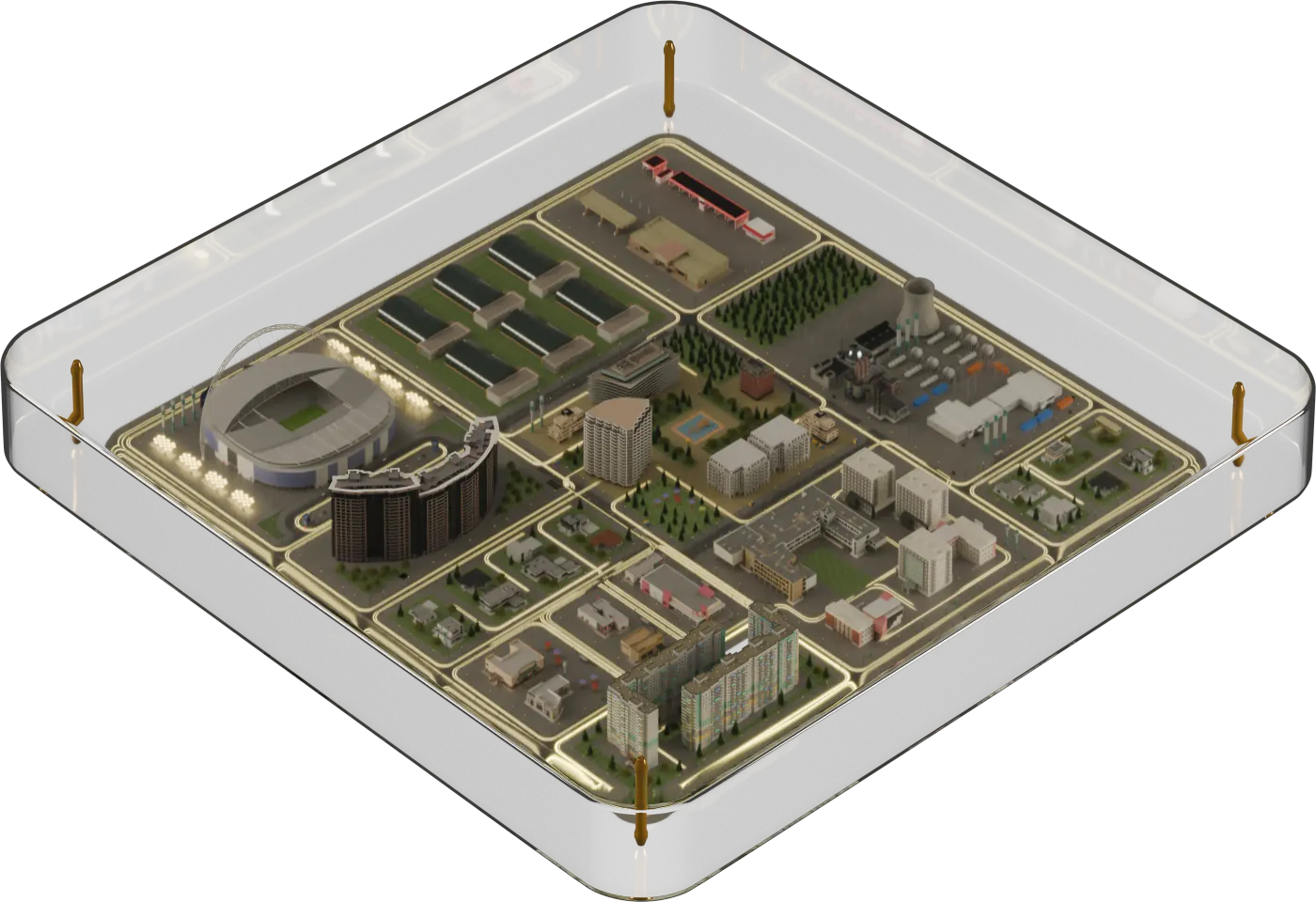
Digital Twins and Simulation
Persistent identity for the physical asset behind every digital representation.
Digital twins, engineering models, simulations, and predictive environments are becoming increasingly important to how infrastructure is designed, operated, analyzed, insured, maintained, and understood.
But every digital representation ultimately depends on one fundamental question.
Which physical asset does this model represent?
The model can change.
The simulation can change.
The platform can change.
Digital Twins and Simulation
The physical asset identity should persist.
PIID™ gives the physical structure a persistent identity that can remain consistent across digital twins, simulations, models, platforms, systems, scenarios, and time.
The identity problem
Digital representations can multiply.The physical asset remains one.
A single structure can be represented across many digital environments.
A design model may use one identifier.
A construction platform may use another.
A digital twin may maintain its own asset key.
A GIS environment may reference geometry.
A simulation engine may reference coordinates.
A facilities platform may maintain another structure ID.
An insurer may reference a policy.
An energy system may reference a service location.
All can describe or model the same physical structure without sharing a persistent identity for the asset itself.
PIID™ establishes that persistent reference.
- Twin ID
- Model ID
- Scenario ID
- BIM ID
The distinction
Twin. Simulation.Physical asset.
Digital Twin
Represents the physical asset and its supported condition, characteristics, systems, geometry, or operational context.
Simulation
Models scenarios, behaviors, risks, changes, conditions, or potential outcomes involving the asset.
PIID™
Persistently identifies the actual physical structure represented by those digital environments.
The twin represents it.
The simulation models it.
PIID™ identifies it.
Physical asset first
The physical structure is the constant.
Digital environments can evolve much faster than physical infrastructure.
A building may remain in service for decades while the software representing it changes repeatedly.
Models are replaced.
Schemas evolve.
Providers change.
Geometry is updated.
Sensors are upgraded.
Platforms are migrated.
Simulation methods improve.
PIID™ provides a persistent structure identity beneath those changes.
Digital representation above. Persistent physical identity below.
The identity anchor
Give every representation a reference to the same physical asset.
A digital twin platform may maintain its own asset identifier.
A simulation environment may maintain another.
A BIM model may use project specific references.
A GIS platform may reference spatial objects.
Those identifiers can remain useful within their respective systems.
PIID™ serves a different role.
It identifies the physical structure across those systems.
A digital twin can reference PIID™.
A simulation can reference PIID™.
A BIM environment can reference PIID™.
A GIS environment can reference PIID™.
An operational system can reference PIID™.
An AI system can reference PIID™.
Different representations. Same physical asset. One persistent identity.
PIID Resolve™
Resolve the digital reference to the physical structure.
PIID Resolve™ identifies, validates, and resolves supported references to persistent infrastructure identity.
Supported inputs can include:
Normalized Address
Parcel
PIID™
Coordinates
Geometry
Supported Source Reference
This allows digital twin and simulation environments to reconcile fragmented references to the same physical structure.
Submit a reference. Resolve the structure. Return persistent identity.
PIID Resolve™Simulation
Simulate the scenario without losing the identity of the asset.
Simulation environments can model countless possible conditions involving the same physical structure.
Storm impact.
Fire exposure.
Flood conditions.
Energy demand.
Structural performance.
Operational changes.
Infrastructure failure.
Climate scenarios.
Insurance loss.
Emergency response.
Urban development.
Capital improvements.
A simulation may create many possible futures.
PIID™ provides a persistent reference to the actual physical structure those scenarios concern.
Many scenarios. One physical asset. One persistent identity.
Scenario continuity
Different outcomes should still reference the same structure.
A structure may be modeled under hundreds or thousands of scenarios.
Different systems may calculate different outcomes.
Different organizations may use different models.
Different providers may maintain different assumptions.
PIID™ provides a consistent structure identity across those analyses.
This creates a stronger foundation for comparing supported results around the same physical asset.
The scenario changes. The structure reference remains.
Digital twin continuity
One physical asset can have many twins through time.
A structure may have multiple digital representations during its lifecycle.
Design models.
Construction models.
Commissioning environments.
Operational twins.
Energy models.
Facilities systems.
Risk models.
Portfolio models.
City scale twins.
Future platforms that do not yet exist.
PIID™ provides a persistent identity capable of maintaining continuity among those representations.
One physical structure. Many digital representations. One persistent identity.
Model continuity
Models should not become the identity of the asset.
A model is a representation of the structure at a particular point in time, for a particular purpose, or within a particular system.
The model may be revised.
Rebuilt.
Migrated.
Archived.
Replaced.
The physical asset can remain.
PIID™ separates the persistent identity of the structure from the temporary identity of the model representing it.
The model describes the asset. PIID™ identifies the asset.
BIM and digital delivery
Carry identity from design into operation.
Architecture, engineering, and construction environments create detailed digital information about structures before and during construction.
But projects eventually end.
The asset continues.
PIID™ provides a persistent structure reference capable of continuing beyond the project environment and into ownership, operations, facilities, insurance, finance, and long term infrastructure workflows.
Supported models and downstream systems can reference the same physical structure through PIID™ as the asset moves through its lifecycle.
The project ends. The structure continues. Its identity should too.
Architecture, Engineering and SurveyingGIS and spatial context
Connect the digital representation to persistent spatial identity.
Digital twin and simulation environments increasingly interact with maps, GIS, imagery, parcels, coordinates, and geospatial analytics.
PIID Resolve™ can reconcile supported spatial references to persistent structure identity.
Together, they can establish continuity among:
Physical Structure
PIID™
Building Geometry
Location
Digital Representation
Simulation Context
Enterprise Systems
Location provides context. Geometry provides form. PIID™ provides persistent identity.
GIS, Mapping and Geospatial IntelligenceLifecycle continuity
Digital representations should understand the asset through change.
Physical structures evolve.
They are planned.
Constructed.
Commissioned.
Insured.
Financed.
Operated.
Inspected.
Maintained.
Renovated.
Repaired.
Expanded.
Transferred.
Repurposed.
Eventually retired.
Lifecycle™ provides the framework through which supported records, events, relationships, and history can remain connected to the same persistent structure identity through those changes.
The model captures a state. Lifecycle™ connects the asset through time.
Lifecycle™Facilities and operations
Carry persistent identity into the operating life of the structure.
Facilities teams may use many systems during the life of a building.
Maintenance platforms.
Work order systems.
Inspection environments.
Building management systems.
Energy systems.
Asset platforms.
Digital twins.
Portfolio applications.
PIID™ gives these environments a persistent structure reference that can continue even as individual technologies change.
Operators change. Systems change. Structure identity remains.
Insurance and catastrophe modeling
Keep modeled risk connected to the physical structure.
Insurance, catastrophe, and risk environments increasingly use detailed property information, geometry, imagery, hazard models, simulations, and portfolio analytics.
PIID™ provides persistent structure identity beneath those analyses.
PIID Resolve™ can reconcile supported references across insurance, risk, property, and geospatial environments.
Simulation outputs can then maintain clearer context around the physical asset being modeled.
Model the risk. Preserve the identity of the asset exposed to it.
Energy and utilities
Simulate infrastructure performance around persistent physical identity.
Energy and utility systems can model demand, consumption, resilience, distributed generation, electrification, service conditions, and infrastructure performance.
PIID™ provides a persistent structure reference around which supported energy and utility context can coordinate.
Digital twins and simulation environments can evolve while continuing to reference the same physical structure.
Conditions change. Infrastructure identity persists.
Smart cities
Persistent identity beneath connected urban models.
City scale digital twins and simulation environments can combine buildings, parcels, utilities, transportation, environmental information, emergency systems, planning data, and infrastructure intelligence.
Those environments become more interoperable when physical structures can be referenced consistently.
PIID™ provides persistent structure identity without requiring every urban system to become one platform.
One city. Many systems. One persistent structure identity.
Smart CitiesManufacturing and industrial
Persistent identity for complex physical environments.
Manufacturing and industrial properties may contain multiple permanent structures, operational environments, engineering systems, energy systems, digital twins, and simulation models.
PIID™ establishes persistent identity at the physical structure level.
This provides a consistent reference for supported operations, engineering, maintenance, risk, energy, analytics, and simulation environments.
UMIP Structure Schedule™ is being developed to document qualifying structures across complex properties through PIID™, location, geometry, and parcel relationship.
Complex site. Multiple structures. Persistent identity for every qualifying physical asset.
Coming Soon
In development
Artificial intelligence
AI needs to know which physical asset the model represents.
Digital twins and simulation are becoming increasingly connected to artificial intelligence.
AI systems can analyze models.
Run scenarios.
Compare outcomes.
Detect change.
Support operations.
Automate decisions.
Predict future conditions.
But intelligent systems still need persistent physical asset context.
PIID™ provides structure identity.
Lifecycle™ provides continuity through time.
Together, these create a stronger persistent reference for AI systems reasoning about the built environment.
Persistent identity creates persistent machine context.
Simulation and AI
Machine generated scenarios still need a real world reference.
Artificial intelligence can generate enormous numbers of scenarios, predictions, and simulated outcomes.
Those outputs become more useful when the physical asset underlying the analysis remains consistently identified.
PIID™ provides that physical reference.
This allows supported intelligent environments to reason across scenarios without repeatedly rebuilding the identity of the structure involved.
More simulations should create more intelligence, not more identity ambiguity.
Cross system interoperability
Digital infrastructure should connect to the enterprise, not become another silo.
Digital twin and simulation platforms often operate alongside:
GIS systems.
BIM environments.
Facilities platforms.
Property systems.
Insurance platforms.
Energy systems.
Government systems.
Enterprise data platforms.
AI systems.
Analytics environments.
Those systems do not need to become one application.
PIID™ gives supported environments a common reference to the physical structure.
Different platforms. Different models. Same physical asset.
Platform independence
Persistent identity should outlive the software.
No digital twin platform, simulation engine, model format, or technology provider should have to remain in place forever for the identity of a physical structure to remain intact.
PIID™ is designed to provide a structure reference independent of any single software platform, digital twin provider, simulation environment, source system, or enterprise technology stack.
Platforms are replaceable. Physical asset identity should be persistent.
Digital portability
Preserve asset identity across generations of technology.
The digital systems surrounding infrastructure will continue evolving.
A structure modeled today may be represented in entirely different systems ten or twenty years from now.
The model can be exported.
The schema can change.
The simulation environment can be replaced.
The twin can migrate.
The underlying physical structure remains.
PIID™ provides the persistent identity capable of carrying that reference forward.
Digital environments evolve. Physical identity persists.
Digital twin and simulation providers
Add persistent physical identity to the platforms customers already use.
Digital twin, modeling, and simulation technology providers can integrate PIID™ as an identity reference within their existing architectures.
PIID™ can complement platform specific asset identifiers by providing a persistent reference to the physical structure represented or modeled.
This can support continuity across:
Model Versions
Simulation Scenarios
Platform Migrations
Portfolio Environments
External Data Sources
Enterprise Applications
Geospatial Systems
Lifecycle Records
AI Workflows
Customer Systems
Give every digital representation an identity reference that exists beyond the representation itself.
Multi structure environments
One simulation environment may represent many physical structures.
Campuses, industrial sites, commercial properties, institutional environments, government complexes, and city scale models may contain multiple qualifying structures.
Each structure can maintain its own PIID™.
UMIP Structure Schedule™ is being developed to document qualifying structures through persistent identity, location, geometry, and parcel relationship.
This creates clearer physical asset context inside complex digital and simulation environments.
One environment. Many structures. Persistent identity for each qualifying asset.
Coming Soon
In development
Data control
Identity does not require centralizing the model.
UMIP does not require digital twin providers, simulation platforms, enterprise customers, or data partners to migrate their underlying models, datasets, simulations, sensor information, or operational systems into UMIP.
Providers retain their models.
Customers retain their systems.
Data environments remain in place.
Existing identifiers can remain.
PIID™ provides the persistent structure reference through which supported information can coordinate.
Connection does not require centralization.
Enterprise delivery
Built for direct integration.
PIID Resolve™ is designed for integration into digital twin, simulation, modeling, geospatial, and enterprise technology environments through structured API delivery.
Supported JSON responses can provide:
Persistent Structure Identity
Verification Context
Registry Context
Structure Context
Building Geometry
Property Context
Supported Source References
Supported file based delivery can also accommodate applicable enterprise exchange workflows.
Integration environments can include:
Digital Twin Platforms
Simulation Engines
BIM Environments
GIS Systems
Facilities Platforms
Risk Systems
Enterprise Applications
Data Platforms
Analytics Systems
Artificial Intelligence
API delivered. Machine readable. Built for integration at scale.
Built on UMIP
Persistent physical identity beneath every digital representation.
PIID™
Provides persistent identity for the physical structure.
PIID Resolve™
Resolves supported references to persistent structure identity.
Lifecycle™
Maintains continuity around structure identity through time.
UMIP Registry™
Maintains persistent infrastructure identity and supported registry context.
UMIP Structure Schedule™
Documents qualifying structures within complex properties through persistent identity.
Coming Soon
In development
Governed by GIIS™
Persistent identity requires consistent rules.
GIIS™ establishes the governance framework for how Persistent Infrastructure Identity is assigned, referenced, resolved, and maintained.
That consistency allows the identity of the physical structure to remain stable as digital twins, simulations, models, platforms, and operating conditions evolve.
Identity establishes the reference. Governance protects its continuity.
At scale
Persistent physical identity for the digital infrastructure economy.
- 189M+PIIDs Registered Across the United States
Digital representations of the built environment will become increasingly detailed.
Simulations will become increasingly powerful.
Artificial intelligence will create more sophisticated models of physical infrastructure.
But the physical asset beneath those environments still needs a persistent identity.
Physical Asset → PIID™ → Digital Twin → Simulation → Lifecycle Continuity → Connected Intelligence
Digital Twins and Simulation
Digital representations change.Physical asset identity should persist.
The future of infrastructure will involve more models.
More simulations.
More sensors.
More automation.
More artificial intelligence.
More digital twins.
And more systems trying to understand the same physical assets.
PIID™ provides the persistent identity those environments can share.
The twin can change.
The simulation can change.
The technology can change.
The physical structure remains. Its identity should remain with it.
Related
Resolve physical structures to persistent infrastructure identities. PIID Resolve™ identifies, validates, and resolves structures from addresses, parcels, coordinates, geometry, and supported source records.