
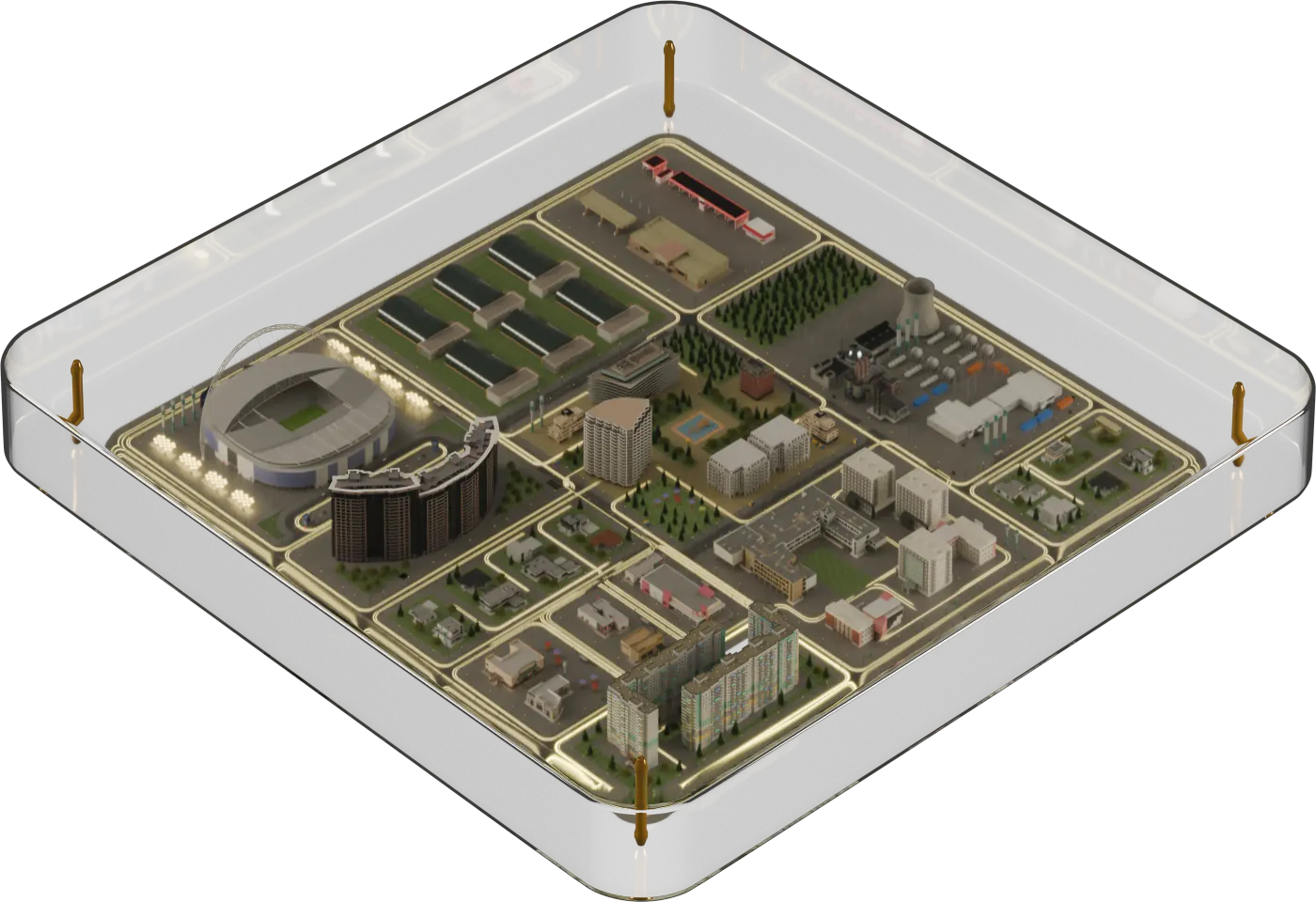
Healthcare and Life Sciences
Persistent structure identity for the physical environments supporting care, research, and discovery.
Hospitals, medical campuses, laboratories, research facilities, pharmaceutical environments, and life sciences properties operate through complex combinations of buildings, engineering systems, utilities, facilities platforms, construction programs, GIS, risk systems, digital models, and enterprise technology.
Those environments can all reference the same physical structures differently.
PIID™ gives each qualifying physical structure a persistent identity that can remain consistent across departments, systems, capital programs, ownership transitions, modernization, and decades of change.
Healthcare and Life Sciences Infrastructure
Critical facilities need identity as persistent as the infrastructure itself.
PIID™ gives each qualifying physical structure a persistent identity that can remain consistent across departments, systems, capital programs, ownership transitions, modernization, and decades of change.
The infrastructure identity problem
Critical environments still depend on fragmented structure references.
Healthcare and life sciences facilities are among the most complex physical environments in the built world.
Yet the same structure may be referenced through:
Addresses.
Parcel identifiers.
Campus building numbers.
Facility codes.
Engineering references.
GIS objects.
Maintenance systems.
Construction project identifiers.
Insurance records.
Utility references.
Digital models.
Enterprise system keys.
Each reference may be valuable inside the environment that created it.
But those references do not necessarily provide one persistent identity for the physical structure itself.
PIID™ establishes that persistent structure reference.
- Building no.
- CMMS
- GIS
- BIM
- Risk
- Engineering
The physical structure as the constant
Care changes. Research changes. Technology changes.The structure remains.
Healthcare and life sciences environments evolve continuously.
Departments move.
Research programs change.
Equipment changes.
Technology changes.
Facilities are renovated.
Systems are replaced.
Operators change.
Ownership can change.
The physical structure may remain in service for decades.
PIID™ provides a persistent structure identity capable of continuing underneath those transitions.
The operating environment changes. Structure identity persists.
Structure identity, not equipment identity
PIID™ identifies the qualifying physical structure.
Healthcare and life sciences facilities contain enormous numbers of specialized operational assets.
Medical equipment.
Laboratory systems.
Mechanical infrastructure.
Electrical systems.
Imaging equipment.
Research equipment.
Building systems.
Production systems.
Those assets should continue using the identifiers, serial numbers, tags, and classifications required by the systems responsible for them.
PIID™ serves a different role.
It persistently identifies the qualifying physical structure that provides context around those operational assets.
Equipment keeps its identifiers. PIID™ identifies the structure.
Multi structure medical campuses
One campus can contain an entire network of physical structures.
Healthcare and life sciences campuses can include:
Hospitals.
Medical office buildings.
Research facilities.
Laboratories.
Clinical buildings.
Administrative facilities.
Utility structures.
Parking structures.
Education facilities.
Storage buildings.
Other qualifying permanent structures.
One address or campus identifier may represent the broader property without distinguishing each structure individually.
PIID™ allows each qualifying structure to maintain its own persistent identity.
One campus. Many structures. Persistent identity for each qualifying asset.
UMIP Structure Schedule™
Document the physical structure inventory of the campus.
UMIP Structure Schedule™ is being developed to document qualifying structures associated with a property through PIID™, location, geometry, and parcel relationship.
For healthcare and life sciences campuses, Structure Schedule™ can create clearer structure level context across complex physical environments.
This can support:
Facilities management.
Capital planning.
Engineering.
Risk review.
Insurance.
Property documentation.
Due diligence.
Campus planning.
Emergency preparedness.
Portfolio management.
Know what structures exist. Know where they are. Know which structure is being referenced.
Coming Soon
In development
PIID Resolve™
Resolve fragmented facility references to persistent structure identity.
PIID Resolve™ identifies, validates, and resolves supported references to the physical structure.
Supported inputs:
Normalized Address
Parcel
PIID™
Coordinates
Geometry
Supported Source Reference
Healthcare and enterprise systems can use PIID Resolve™ to reconcile different representations of the same physical structure around one persistent identity.
Submit a reference. Resolve the structure. Return persistent identity.
PIID Resolve™Facilities management
Persistent identity beneath the systems that keep critical facilities operating.
Healthcare facilities operate through extensive facilities environments.
CMMS.
Enterprise asset management.
Building management systems.
Inspection platforms.
Engineering systems.
Energy platforms.
Safety systems.
GIS.
Digital twins.
Enterprise applications.
PIID™ gives supported systems a persistent reference to the same physical structure.
Different operating systems. Same facility. One persistent identity.
Asset management and CMMS
The maintenance system can change.The structure identity should not.
CMMS and asset management environments organize maintenance, work orders, inspections, facilities activity, and operational assets.
Those platforms often use their own site codes, facility numbers, building identifiers, and location hierarchies.
PIID™ does not replace those references.
It provides a persistent structure level identity underneath them.
A legacy system can reference PIID™.
A replacement system can reference the same PIID™.
Migrate the system. Preserve the structure reference.
Maintenance continuity
Thousands of maintenance events.One physical structure.
A healthcare structure can accumulate decades of:
Preventive maintenance.
Corrective maintenance.
Inspections.
Mechanical upgrades.
Electrical improvements.
Roof work.
Renovations.
Life safety improvements.
Energy projects.
Capital repairs.
Different teams and systems may manage those records at different times.
PIID™ provides the persistent structure identity around which supported maintenance context can remain connected.
The work changes the facility. The identity carries forward.
Capital programs
Critical facilities are rarely finished.
Hospitals and life sciences environments are continuously modified.
Renovation.
Expansion.
Department relocation.
Laboratory modernization.
Mechanical upgrades.
Electrical improvements.
Energy projects.
New clinical environments.
Research expansion.
Infrastructure replacement.
Each program can introduce new project teams, systems, documents, models, and identifiers.
PIID™ provides persistent structure identity underneath those changes.
New program. Same structure. Same persistent identity.
CAD, BIM and digital delivery
Carry identity from design into long term operation.
Healthcare and life sciences projects generate extensive architectural, engineering, BIM, and digital delivery information.
Models change.
Project identifiers change.
Project teams leave.
The facility remains.
PIID™ provides a structure identity capable of continuing beyond the project and into facilities operations, future renovations, insurance, risk, energy, and enterprise systems.
The project ends. The structure continues. Its identity should too.
Engineering continuity
Different engineering disciplines.Same physical facility.
Healthcare and life sciences infrastructure can involve extensive:
Structural engineering.
Mechanical engineering.
Electrical engineering.
Civil engineering.
Environmental engineering.
Energy engineering.
Specialized laboratory engineering.
Facility engineering.
Each discipline may maintain different project references and systems.
PIID™ provides a common structure identity through which supported engineering context can remain associated with the same physical asset.
Different disciplines. Same structure. Persistent identity between them.
Laboratories and research facilities
Research environments change faster than the structures supporting them.
Laboratories and research facilities can experience continual change.
Research programs evolve.
Equipment changes.
Funding changes.
Tenants change.
Specialized spaces are reconfigured.
Technology is replaced.
The physical facility may remain.
PIID™ provides persistent structure identity beneath those changing environments.
This creates a stable physical reference across supported facilities, engineering, risk, property, energy, and enterprise systems.
Research evolves. Structure identity persists.
Life sciences and pharmaceutical facilities
Persistent identity beneath complex regulated physical environments.
Life sciences and pharmaceutical facilities can include laboratories, research buildings, production environments, administrative facilities, utilities, storage structures, and other specialized buildings.
These facilities may operate across multiple engineering, facilities, compliance, risk, property, and enterprise systems.
PIID™ provides a persistent identity for each qualifying physical structure beneath those environments.
Different systems. Same facility. One persistent structure identity.
Clinical infrastructure
The care environment changes.The physical structure remains.
Clinical facilities may undergo repeated transformation as technology, treatment models, departments, workflows, and operational requirements change.
The same structure can serve different functions across decades.
PIID™ provides a persistent structure identity capable of maintaining continuity beneath those changes.
Clinical use can change. Structure identity persists.
Energy and critical utilities
Critical care depends on critical infrastructure.
Healthcare and life sciences facilities depend on complex energy and utility environments.
Electrical service.
Backup generation.
Water.
Gas where applicable.
Mechanical systems.
Cooling.
Heating.
Communications.
Resilience systems.
Distributed energy.
Storage.
Those systems may maintain different facility, service, meter, account, or operational references.
PIID™ provides persistent structure identity capable of complementing those environments.
Service relationships change. Structure identity remains.
Resilience
Critical facilities need continuity through disruption and recovery.
Severe weather, fire, infrastructure failure, environmental events, and other disruptions can involve:
Facilities teams.
Engineers.
Utilities.
Emergency organizations.
Insurers.
Contractors.
Government agencies.
Recovery teams.
PIID™ provides a persistent structure reference capable of remaining consistent through planning, disruption, assessment, repair, and recovery.
Before the event. During the event. After the event. Same structure identity.
Emergency management
The structure should not change identity when conditions become critical.
Emergency planning and response depend on clear physical context.
A hospital campus may contain multiple buildings with different roles and risk profiles.
PIID™ provides persistent structure identity.
Structure Schedule™ can provide a clearer inventory of qualifying structures across the campus.
Know which structure. Know where it is. Maintain the same reference through the event.
Insurance and risk
Resolve physical risk to the correct healthcare structure.
Healthcare and life sciences facilities can represent significant concentrations of physical, operational, and financial exposure.
Insurance and risk environments may analyze:
Property exposure.
Catastrophe risk.
Fire.
Flood.
Storm.
Business interruption.
Facility resilience.
Physical damage.
Operational dependencies.
PIID™ provides persistent structure identity beneath supported risk workflows.
UMIP Structure Schedule™ can provide clearer structure level context across complex campuses.
Know which structure carries the risk. Persistently.
Property and real estate
Healthcare infrastructure is also a physical real estate portfolio.
Health systems, universities, research institutions, pharmaceutical companies, and life sciences organizations may own or operate large portfolios of physical properties.
Those assets can move through:
Acquisitions.
Disposition.
Development.
Leasing.
Financing.
Insurance.
Capital planning.
Facilities operations.
Portfolio management.
PIID™ provides persistent identity at the structure level across supported property workflows.
Ownership changes. Structure identity does not need to.
Portfolio management
One persistent structure reference across the portfolio.
Large healthcare and life sciences organizations may operate hundreds or thousands of structures acquired through different systems, regions, projects, and ownership histories.
PIID™ provides persistent structure identity across supported portfolios.
This can support:
Portfolio Normalization.
Structure Reconciliation.
Property Alignment.
Capital Planning.
Risk Analysis.
Facilities Operations.
Insurance.
Energy Analysis.
Enterprise Reporting.
Infrastructure Intelligence.
One portfolio. Many structures. Persistent identity at the structure level.
Acquisitions and integration
Integrate the facility without rebuilding its identity.
Healthcare systems and life sciences organizations can grow through acquisition.
New properties may arrive with:
Different building numbers.
Different CMMS platforms.
Different GIS references.
Different property IDs.
Different engineering systems.
Different naming conventions.
PIID™ provides a persistent structure reference capable of remaining consistent as the facility enters a new organization.
New owner. New systems. Same physical structure.
GIS, mapping and geospatial intelligence
Connect campus geography to persistent structure identity.
Healthcare and research campuses depend on maps, coordinates, parcels, imagery, building footprints, and GIS.
Those systems provide spatial context.
PIID™ provides persistent identity for the physical structure itself.
PIID Resolve™ can reconcile supported spatial references to structure identity.
Location tells you where. PIID™ tells you which structure.
Digital twins and simulation
Give every digital representation a persistent physical reference.
Healthcare and life sciences facilities increasingly use digital models, simulations, digital twins, predictive systems, and operational analytics.
Those representations can change continuously.
PIID™ identifies the physical structure beneath them.
Lifecycle™ provides continuity through time.
Digital representations change. Physical asset identity should persist.
Campus planning
Plan the future around structures that retain their identity.
Large medical and research campuses evolve over decades.
New buildings are constructed.
Existing structures are renovated.
Departments move.
Utilities expand.
Transportation changes.
Research programs evolve.
Properties are acquired.
PIID™ provides persistent structure identity beneath those planning cycles.
The campus evolves. The structures retain their identity.
Lifecycle continuity
Critical facilities can serve generations.
A hospital or research structure may remain in service for decades.
During that time it can experience:
Renovations.
Maintenance.
Department changes.
Capital programs.
Technology replacement.
Ownership transitions.
Insurance events.
Energy modernization.
Engineering projects.
Lifecycle™ provides the framework through which supported records, events, relationships, and history can remain connected around the same PIID™.
The environment changes. The structure identity carries forward.
Lifecycle™Artificial intelligence
AI needs persistent context for the physical facilities it analyzes.
Artificial intelligence can increasingly interact with:
Facilities information.
Maintenance records.
Engineering documents.
Energy information.
Geospatial data.
Risk models.
Digital twins.
Property information.
Infrastructure analytics.
Without persistent identity, intelligent systems may repeatedly need to determine which physical structure those records describe.
PIID™ provides persistent structure identity.
Lifecycle™ provides continuity through time.
Persistent identity creates persistent machine context.
Smart buildings and automation
More intelligent systems increase the need for persistent asset context.
Healthcare and research facilities are becoming more connected and automated.
Building systems.
Sensors.
Controls.
Analytics.
Facilities platforms.
Digital twins.
AI agents.
Automation can become more useful when the physical structure maintains a consistent identity across the information being processed.
More intelligence should not create more identity ambiguity.
Cross system interoperability
Critical facilities do not need one database.
CMMS can remain CMMS.
GIS can remain GIS.
BIM can remain BIM.
Engineering systems can retain their role.
Energy platforms can retain their role.
Property systems can retain their role.
Digital twins can remain digital twins.
Enterprise applications can retain their own records.
PIID™ provides a persistent structure reference through which supported systems can coordinate around the same physical asset.
Different systems retain their role. Identity becomes the connection point.
Data control
Persistent identity does not require centralizing healthcare infrastructure data.
UMIP does not require healthcare organizations, research institutions, facilities teams, engineering firms, technology providers, or data partners to move all underlying information into one repository.
Existing systems can remain.
Existing identifiers can remain.
Provider records can remain within the environments responsible for them.
PIID™ provides the persistent structure reference through which supported information can coordinate.
Connection does not require centralization.
System independence
The structure can outlive every technology platform around it.
A hospital or laboratory may remain operational far longer than many of the CMMS, GIS, BIM, engineering, facilities, or enterprise systems surrounding it.
PIID™ provides a structure identity independent of any single software platform or technology provider.
Platforms are replaceable. Physical structure identity should persist.
Enterprise delivery
Built for integration into infrastructure systems.
PIID Resolve™ is designed for structured enterprise integration.
Supported JSON responses:
PIID™
Verification Context
Registry Context
Structure Context
Building Geometry
Property Context
Supported Source References
Integration environments:
Facilities platforms.
CMMS.
EAM.
GIS.
Engineering systems.
BIM.
Energy platforms.
Risk applications.
Digital twins.
Property systems.
Enterprise data environments.
Artificial intelligence.
Supported file based delivery can also accommodate applicable enterprise exchange workflows.
API delivered. Machine readable. Built for integration at scale.
Built on UMIP
Persistent identity beneath healthcare and life sciences infrastructure.
PIID™
Provides persistent identity for each qualifying physical structure.
PIID Resolve™
Resolves supported facility, spatial, property, and source references to persistent structure identity.
Lifecycle™
Maintains continuity around structure identity through time.
UMIP Registry™
Maintains persistent infrastructure identity and supported registry context.
UMIP Structure Schedule™
Documents qualifying structures across complex campuses.
Coming Soon
In development
Governed by GIIS™
Persistent infrastructure identity requires consistent rules.
Healthcare and life sciences infrastructure spans facilities, campuses, operators, owners, engineering firms, technology providers, insurers, utilities, enterprise systems, and decades of physical asset life.
GIIS™ establishes the governance framework supporting consistent Persistent Infrastructure Identity across those environments.
PIID™ provides the structure identity.
GIIS™ provides the governance foundation supporting its continuity.
Identity establishes the reference. Governance protects its continuity.
At scale
Persistent identity for critical facilities at national scale.
- 189M+PIIDs Registered Across the United States
Healthcare and life sciences facilities will continue becoming more connected, automated, specialized, and intelligent.
The physical structures beneath those systems still need a persistent identity capable of continuing through generations of technological, organizational, and operational change.
Structure Identity → Interoperability → Lifecycle Continuity → Infrastructure Intelligence
Healthcare and Life Sciences Infrastructure
The systems supporting care and discovery will change.The physical infrastructure will remain.
Clinical technology changes.
Research changes.
Equipment changes.
Facilities systems change.
Engineering programs change.
Ownership can change.
Capital programs continue.
The physical structure remains.
PIID™ gives qualifying healthcare and life sciences infrastructure a persistent identity capable of continuing across the systems, organizations, and programs responsible for it.
Critical facilities need identity as persistent as the infrastructure itself.
Related
Resolve physical structures to persistent infrastructure identities. PIID Resolve™ identifies, validates, and resolves structures from addresses, parcels, coordinates, geometry, and supported source records.
Establishes how supported records, attributes, events, relationships, and history remain connected to that identity through time.
Identify and organize the permanent structures associated with a property, with each qualifying structure referenced through its own PIID™.