
PIID Resolve™
Structure Identity Resolution
Resolve physical structures to persistent infrastructure identities.
PIID Resolve™ identifies, validates, and resolves structures from addresses, parcels, coordinates, geometry, PIID™, and supported source records.
Instead of treating each identifier as a separate representation of the asset, PIID Resolve™ reconciles supported records to the same physical structure, creating continuity across systems, datasets, workflows, ownership changes, and time.
Enterprise systems receive a consistent structure identity that can connect records, reduce duplication and matching errors, improve data quality, and maintain a persistent reference to the same physical asset wherever it appears.
Enterprise API delivery through structured JSON responses for direct system integration.
- 189M+Persistent Infrastructure Identities Registered Across the United States.
Identity Resolution API™
Submit a reference. Resolve the structure. Return persistent identity.
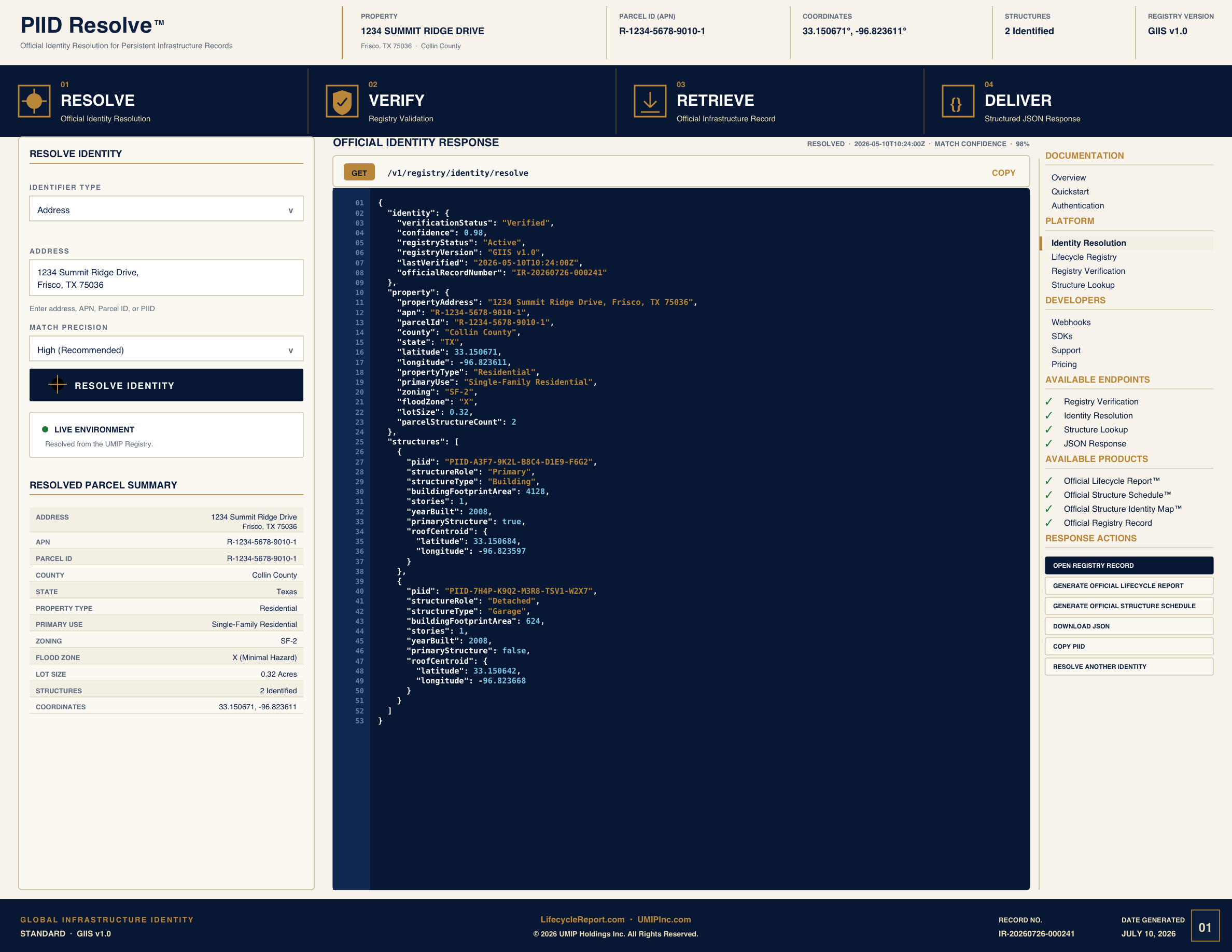
Provide a supported structure reference. PIID Resolve™ reconciles it to the physical structure. A structured JSON response returns the resolved PIID™, verification information, and supported property and structure context.
The identity problem
The reference changes. The structure does not.
The same physical structure can appear differently across systems.
One system may reference an address.
Another may reference a parcel.
Another may use coordinates.
Another may use geometry.
A data provider may maintain its own identifier.
An enterprise platform may create another internal key.
All can describe the same physical asset without sharing a common identity.
PIID Resolve™ reconciles those fragmented references around the structure itself.
Identity before integration.
Enterprise systems cannot reliably coordinate information about a physical asset until they know which structure the information belongs to.
PIID Resolve™ establishes that reference.
Once the structure is resolved to PIID™, supported systems, records, applications, and workflows can reference the same physical asset through one persistent identity.
Different identifiers. Same physical structure. One persistent identity.
How PIID Resolve™ works
Submit
Provide a supported structure reference.
- Normalized Address
- Parcel
- Structure Reference
- PIID™
- Coordinates or Geometry
- Supported Source Reference
Resolve
PIID Resolve™ reconciles the submitted reference to the physical structure represented by the request.
Verify
The resolved identity is validated against UMIP Registry™ to establish identity status, registry continuity, and supported verification context.
Return
A structured JSON response returns the resolved PIID™, verification information, and supported property and structure context for enterprise use.
Submit a reference. Resolve the structure. Return persistent identity.
A machine readable structure identity response.
Canonical PIID™
The persistent identity associated with the resolved physical structure.
Verification Status
Indicates the verification state of the resolved identity.
Registry Status
Provides supported registry status and continuity information.
Property Context
Returns supported property references associated with the resolved structure.
Structure Context
Returns supported structure level information associated with the PIID™.
Resolution Confidence
Provides supported confidence information for the identity resolution result.
Source References
Maintains supported references used to establish and reconcile structure identity.
Structured JSON
Returns identity information in a consistent machine readable response designed for enterprise integration.
How it differs
Resolution identifies the structure itself.
Address matching identifies a string.
Geocoding identifies a location.
Parcel lookup identifies land.
Coordinate matching identifies a point or geographic reference.
PIID Resolve™ identifies the physical structure.
The result is a canonical PIID™ and supported verification context that can remain consistent even when the references surrounding the structure change.
Resolve identity before ambiguity moves downstream.
Reduce Duplicate Records
Reconcile multiple representations of the same physical structure around one persistent identity.
Improve Matching
Reduce uncertainty when records from different systems describe the same asset differently.
Strengthen Data Quality
Establish structure identity before information moves into downstream applications and workflows.
Maintain Continuity
Keep the same physical structure resolved as systems, ownership, records, and data providers change.
Connect Systems
Give existing applications and datasets a persistent reference to the same physical asset.
Support Automation
Provide automated workflows with a consistent structure identity instead of repeatedly reconciling fragmented references.
Give AI Persistent Context
Provide intelligent systems with a stable physical asset reference across data sources, records, events, and time.
Identity delivered directly into the systems that use it.
PIID Resolve™ is delivered through enterprise APIs using structured JSON responses.
Technical teams can integrate persistent structure identity directly into applications, data platforms, analytics environments, decision systems, risk solutions, geospatial environments, automation workflows, and enterprise infrastructure.
API delivered. Machine readable. Built for integration at scale.
Resolve identity without surrendering your data architecture.
PIID Resolve™ does not require customers or data providers to replace their existing identifiers, databases, or systems.
Existing systems retain their records and their role.
PIID™ provides a persistent reference that allows supported records to resolve to the same physical structure.
Your systems remain in place. Identity becomes interoperable.
Multiple references.One structure identity.
Address Resolution
Reconciles normalized, postal, delivery, and supported legacy address references to structure identity.
Parcel Resolution
Reconciles supported parcel references to the physical structures associated with them.
Structure Resolution
Resolves a supported physical structure reference to a canonical PIID™.
PIID™ Resolution
Returns the supported registry identity and structure context associated with a PIID™.
Coordinate and Geometry Resolution
Resolves supported coordinates, geometry, and spatial references to identified physical structures.
Cross Reference Resolution
Reconciles supported third party identifiers, source keys, and enterprise references to PIID™.
Resolution is the access point. Persistent identity is the foundation.
The persistent infrastructure identity assigned to the physical structure.
The trusted system of record used to maintain and verify infrastructure identity.
Creates a connected structure and lifecycle record around persistent identity.
Documents the qualifying structures associated with a property through persistent identity. Coming Soon
Persistent Infrastructure Identity in the public record.
Independent industry coverage documents the emergence of Persistent Infrastructure Identity across infrastructure, engineering, technology, property, risk, and the built environment.
Digital Construction · 2026-08-07
The built environment has an identity crisisIndependent coverage in Digital Construction.
CCR-Mag · 2026-08-04
The Built Environment Is Missing an Identity LayerIndependent coverage in CCR-Mag.
Mecklenburg Times · 2026-07-30
Why your building's address was never meant to be its identityIndependent coverage in Mecklenburg Times.
Give your systems a persistent reference to the physical structure.
Integrate PIID Resolve™ through enterprise APIs and structured JSON responses.