
Lifecycle Report™
The verified lifecycle record for infrastructure.
Lifecycle Report™ brings structure identity, property intelligence, records, documents, events, and insights together around one persistent infrastructure identity.
Every report is anchored to PIID™, allowing supported information to reference the same physical structure across ownership, insurance, financing, permits, improvements, risk, and time.
A conventional property report describes a property at a moment in time.
Lifecycle Report™ is organized around the identity and lifecycle of the physical structure itself.
Product
One structure. One identity. One connected lifecycle record.
Why Lifecycle Report™
Property data is abundant.Continuity is not.
Information about a structure exists across government records, property databases, permits, insurance systems, transactions, contractors, risk providers, geospatial sources, and other environments.
Those records may describe the same physical asset without sharing a persistent identity.
Lifecycle Report™ organizes supported infrastructure intelligence around PIID™, creating a clearer connection between the structure and the information associated with it.
Identity gives the record continuity through time.
Built around PIID™
The structure is the reference point.
PIID™ provides the persistent identity around which Lifecycle Report™ is organized.
Instead of treating an address or parcel as the permanent reference, the report centers supported information around the physical structure itself.
As ownership, financing, insurance, records, and surrounding systems change, PIID™ provides continuity to the same asset.
The records can change. The identity persists.
What is included
A connected view of the structure and its lifecycle.
Lifecycle Report™ organizes supported infrastructure intelligence across the areas most relevant to understanding the physical asset.
Structure Identity
PIID™, identity status, structure references, and supported registry context.
Property Context
Address, parcel, location, property characteristics, and supported property information.
Structure Intelligence
Qualifying structures, structure characteristics, physical context, and supported identity relationships.
Permits and Improvements
Supported permit activity, improvements, renovations, and related lifecycle events.
Ownership and Transaction Context
Supported property ownership, transaction, and historical information.
Risk and Hazard Intelligence
Supported environmental, catastrophe, storm, and property risk information.
Contractor and Project Activity
Supported contractor, construction, improvement, and project related information.
Community and Location Intelligence
Supported neighborhood, proximity, accessibility, and surrounding property context.
Lifecycle History
A chronological view of supported events and changes connected to the structure through time.
Infrastructure Intelligence
Additional supported information relevant to understanding the structure, its environment, and its lifecycle.
The identity advantage
Every section references the same physical structure.
Traditional property information is frequently assembled around an address, parcel, or transaction.
Lifecycle Report™ begins with persistent structure identity.
That distinction allows supported records, events, attributes, and intelligence to be organized around the same physical asset rather than simply grouped by location.
Identity before information. Continuity before complexity.
Structure level clarity
One property may contain multiple structures.
An address can describe a location.
A parcel can describe land.
Neither necessarily distinguishes every qualifying structure on the property.
Lifecycle Report™ uses PIID™ to establish structure level identity so supported information can be associated with the appropriate physical asset.
Where applicable, structure inventory information can distinguish qualifying structures individually rather than treating the entire property as a single building.
Know what structures exist. Know which structure the information describes.
UMIP Structure Schedule™
Structure identity documentation for complex properties.
UMIP Structure Schedule™ creates a documented inventory of qualifying structures associated with a property, identifying each through its PIID™, location, and relationship to the parcel.
Structure Schedule™ is being developed as a dedicated product for underwriting, transactions, portfolios, diligence, documentation, and multi structure properties.
Lifecycle Report™ and Structure Schedule™ share the same persistent identity foundation while serving different workflows.
Coming Soon
In development
Built for decisions
One record.Multiple decision environments.
Homeowners and Buyers
Understand the structure, its history, and supported property information through one organized record.
Real Estate Transactions
Create clearer structure context for diligence, purchase decisions, ownership transitions, and documentation.
Insurance
Support underwriting, property review, claims context, and structure level risk analysis.
Mortgage and Lending
Support collateral review, property diligence, and understanding of the physical structure associated with the loan.
Commercial Real Estate
Provide structure level context across acquisitions, ownership, operations, portfolio review, and disposition.
Portfolio Management
Create consistent identity based views across multiple physical assets.
Facilities and Operations
Support long term understanding of structures, improvements, records, and lifecycle context.
The report in practice
Identity carries the record.
A structure can be purchased.
Financed.
Insured.
Renovated.
Inspected.
Repaired.
Transferred.
Operated.
And eventually sold again.
The systems and organizations surrounding it may change repeatedly.
PIID™ provides the persistent identity.
Lifecycle Report™ organizes supported intelligence around that identity.
One physical structure across decades of change.
Product evidence
See the record.
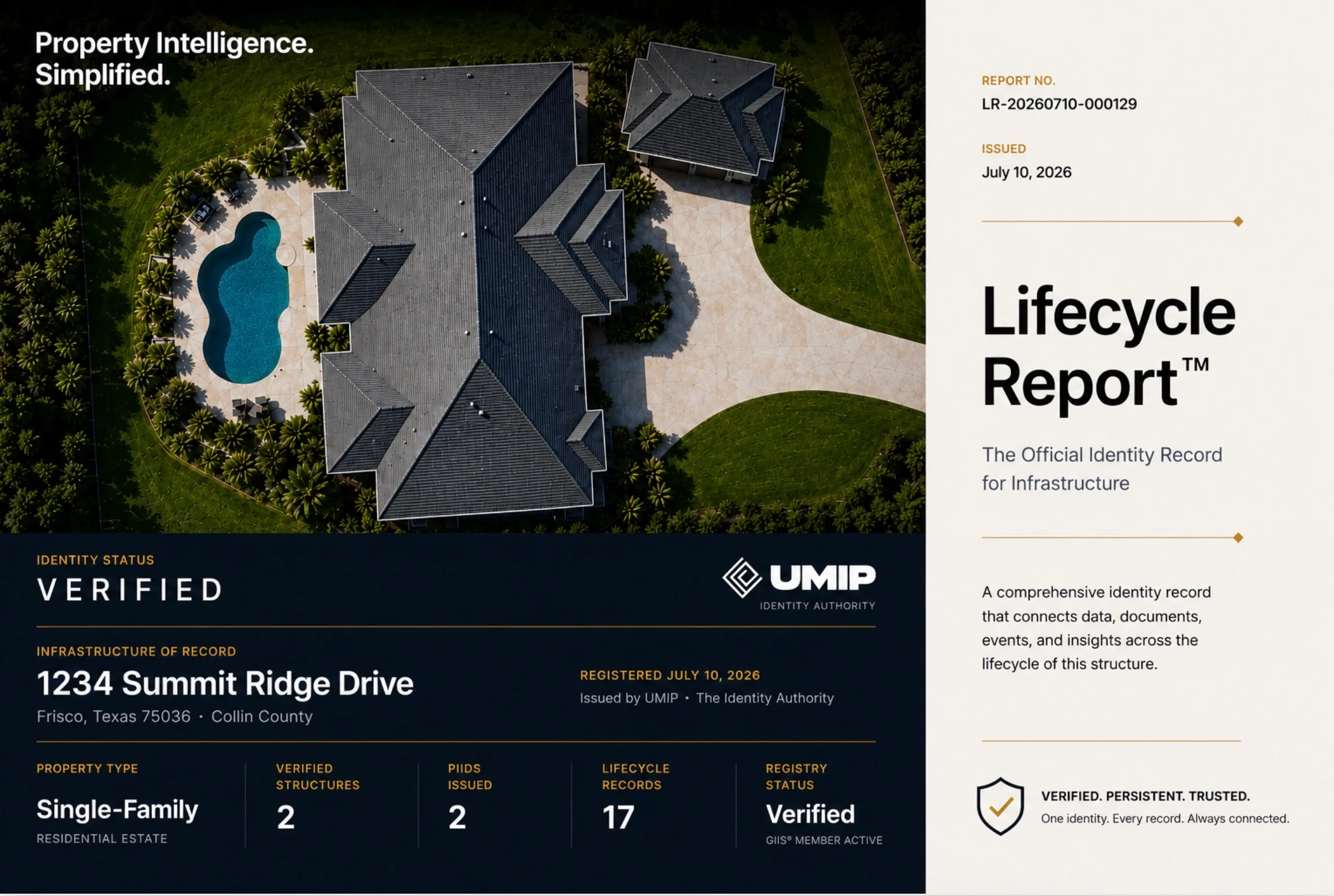
Lifecycle Report™ presents verified structure identity and supported infrastructure intelligence through a professionally organized report designed for consumers, professionals, institutions, and enterprise workflows.
Verified structure identity
Every report begins with identity.
Lifecycle Report™ is generated around a resolved physical structure and its PIID™.
Supported identity information is validated against UMIP Registry™ before the report is generated, providing a consistent structure reference for the information presented within the report.
Resolve the structure first. Build the record around it.
PIID Resolve™UMIP Registry™
Persistent identity behind the report.
UMIP Registry™ maintains the infrastructure identity, supported source relationships, verification history, and registry context associated with PIID™.
Lifecycle Report™ uses that identity foundation to organize supported information around the same physical structure.
The Registry does not require every underlying source record or provider dataset to be permanently stored within UMIP.
Persistent identity. Connected references. Verified continuity.
UMIP Registry™How it differs
More than a property snapshot.
A conventional property report typically aggregates information associated with an address or parcel.
Lifecycle Report™ organizes supported infrastructure intelligence around the persistent identity of the physical structure.
That creates a different foundation.
Property report
Information assembled around a property reference.
Lifecycle Report™
Information organized around a persistent structure identity and connected through time.
The difference is identity.
Platform foundation
Built on persistent infrastructure identity.
Provides the persistent identity of the physical structure.
Resolves fragmented references to the same physical structure.
Maintains persistent structure identity, verification context, and supported source relationships.
Provides documented structure identity inventory for qualifying structures. Coming Soon
Report access
Built for individual and enterprise use.
Lifecycle Report™ can support individual property evaluation as well as professional, institutional, and portfolio workflows.
For enterprise requirements, contact UMIP to discuss volume access, workflow integration, portfolio applications, and supported delivery options.
Report purchase terms
Platform access and account terms.
Information practices for the UMIP platform.
Persistent Infrastructure Identity in the public record.
Independent industry coverage documents the emergence of persistent infrastructure identity across insurance, construction, real estate, facilities, infrastructure, and other sectors.
Facility Executive · 2026-08-11
What The Former Pfizer HQ Failure Should Make You Ask About Your FacilityIndependent coverage in Facility Executive.
Digital Construction · 2026-08-07
The built environment has an identity crisisIndependent coverage in Digital Construction.
Institutional Real Estate · 2026-08-07
The built environment has an identity crisisIndependent coverage in Institutional Real Estate.
One structure. One identity. A record that carries forward.
Lifecycle Report™ gives the physical structure a connected record organized around the identity that persists with it through time.