Skip to content

The Infrastructure Identity Gap™

Why the built environment lacks a persistent identity layer, and what changes when one exists.

Editorial essay

This essay teaches the problem before the standard. It is not a product brief.

Unlike vehicles, financial transactions, products, and scholarly publications, buildings and infrastructure lack a persistent digital identity. This absence creates fragmented records, operational inefficiencies, and limits interoperability across the built environment. The Infrastructure Identity Gap™ describes this missing foundational layer and introduces Persistent Infrastructure Identity (PIID™) and the Global Infrastructure Identity Standard (GIIS™) as a framework for addressing it.

01 · The invisible problem

The built world runs on proxies.

Nearly every major physical asset is known differently in every system that touches it. The same structure may appear under a parcel number in one database, an address string in another, a policy number in a third, and a project identifier in a fourth.

None of those identifiers was designed to be the permanent identity of the structure itself. They describe land, location, risk, ownership, or work. They do not describe the asset as a continuous entity across time.

The result is not a data inconvenience. It is a structural condition of the infrastructure economy: critical records accumulate around the same physical thing without a shared identity to hold them together.
02 · A building without an identity

One structure. Dozens of temporary names.

Consider a single commercial building across decades of ordinary activity. Each system that encounters it creates another identifier.

Parcel IDs, county records, postal addresses, tax accounts, insurance policies, permit numbers, mortgage instruments, utility accounts, construction documentation, facility systems, GIS layers, inspection files, and maintenance platforms all attach their own labels.

Every label is useful inside its own domain. None becomes the permanent identity of the structure. When ownership changes, systems migrate, jurisdictions update, or records are restated, the building remains — while its digital references scatter.

  • Parcel ID
  • County records
  • Address
  • Tax records
  • Insurance records
  • Permit numbers
  • Mortgage records
  • Utility identifiers
  • Construction documentation
  • Facility management systems
  • GIS records
  • Inspection records
  • Maintenance systems

03 · The cost of fragmentation

Fragmented identity is the ceiling on every downstream system.

When identity is approximate, history becomes approximate. Duplicate records proliferate. Verified events detach from the assets they concern. Transfers, claims, inspections, and capital work become harder to reconcile because the systems involved do not share a durable reference.

The effects appear wherever institutions must reason about structures over time: underwriting and insurance operations, construction and facilities coordination, government administration, property transfer, disaster response, asset management, digital twins, and artificial intelligence trained on incomplete joins.

Addresses describe destinations. Parcels describe land ownership. Permits reference projects. Policies reference risks. Coordinates drift with every survey. The infrastructure economy continues to operate on these approximations — and pays for them in delay, duplication, and unresolved history.

  • Duplicate records

    The same structure appears as multiple entities across systems of record.

  • Disconnected history

    Lifecycle events accumulate without a permanent identity to preserve continuity.

  • Operational friction

    Insurance, construction, government, and transfer workflows reconcile proxies instead of identity.

  • Machine limits

    AI systems, digital twins, and analytics inherit the same fragmentation they attempt to overcome.

04 · The Infrastructure Identity Gap™

Every major information system has persistent identity. Infrastructure does not.

Vehicles have VINs. Published works have ISBNs and DOIs. Financial messages move on SWIFT. Global trade identifies products through GS1 standards. The internet routes on IP addresses. Navigation depends on GPS.

These systems exist because modern economies require durable, transferable, machine-readable identity for the things that matter.

Infrastructure — buildings, facilities, utilities, transportation assets, and the broader built environment — still lacks an equivalent. The Infrastructure Identity Gap™ is that absence: the missing identity layer between physical assets and the independent systems that depend on them.

VIN
Vehicles
ISBN
Publishing
DOI
Research objects
SWIFT
Financial messaging
GS1
Global trade
IP / GPS
Networks and location
Why not infrastructure?

UMIP

Comparison

Identity exists everywhere except infrastructure

Major information systems solved persistent identity decades ago. The built environment has not.

Persistent identifiers by system, including infrastructure today
SystemPersistent Identifier
VehiclesVIN
BooksISBN
ResearchDOI
Financial MessagesSWIFT
ProductsGS1 / GTIN
InfrastructureNone (Today)

Persistent Infrastructure Identity (PIID™) is proposed as the identity layer for infrastructure.

05 · Persistent Infrastructure Identity™

One structure. One identity. One permanent record.

Persistent Infrastructure Identity (PIID™) is the foundational identifier for infrastructure. A single structure receives a single PIID. That identity is preserved for the life of the asset.

PIID is designed to survive the events that break every other system of record. It does not depend on any single dataset, any single jurisdiction, or any single vendor. It is the permanent identity every downstream system — public, private, and machine — can align on.

Persistent

Preserved across ownership, systems, and institutional change.

Neutral

Not owned by a single industry workflow or proprietary silo.

Permanent

Assigned once per structure and retained for the life of the asset.

System-independent

Exists above applications rather than inside one vendor record.

Machine-readable

Structured for registries, resolution, and computational use.

Globally unique

One identifier per structure within the governed identity namespace.

06 · The Infrastructure Identity Layer

Identity sits above systems. It does not replace them.

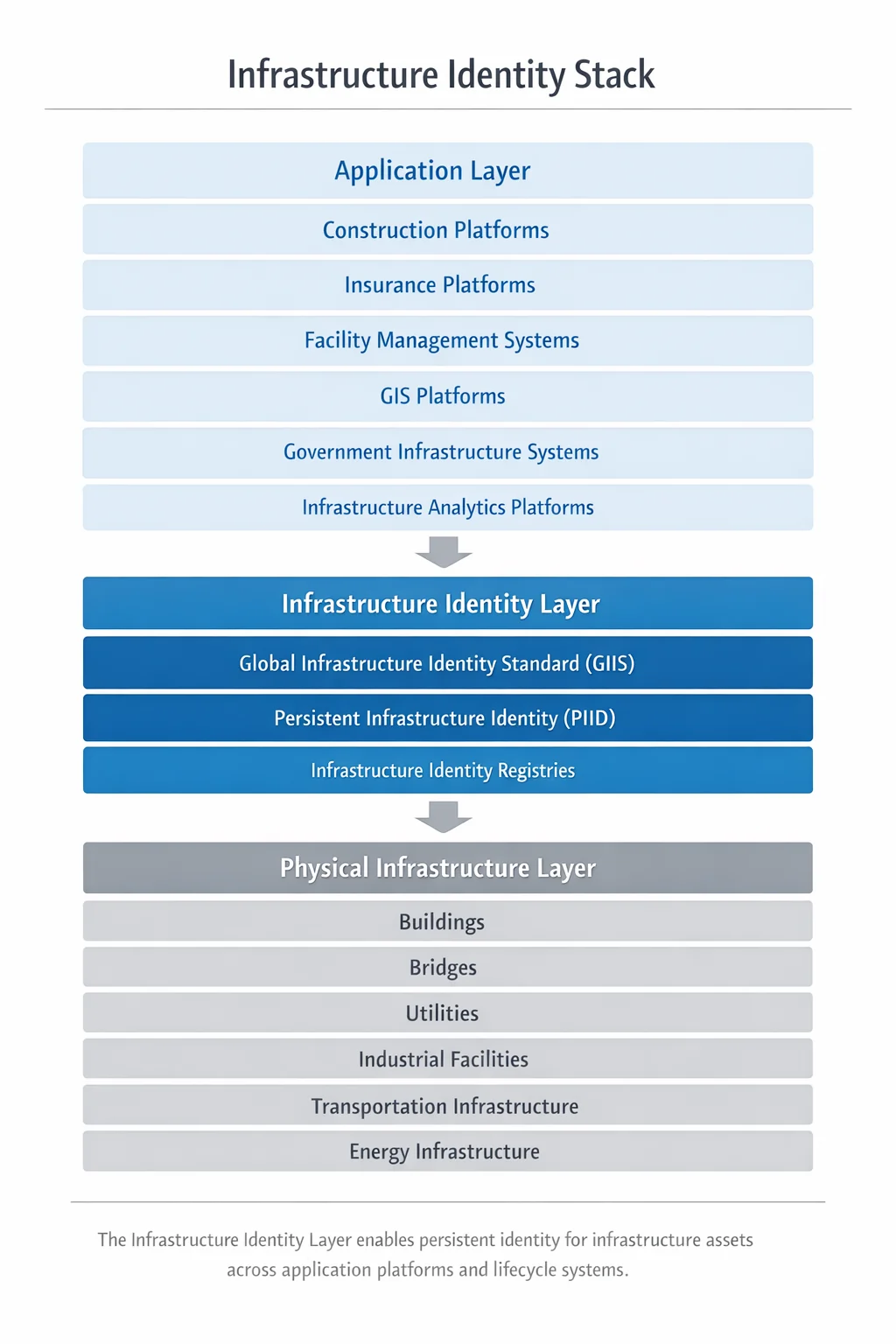
PIID does not ask insurance platforms, facility systems, GIS environments, construction tools, or government records to disappear. Those systems continue to perform their roles.

What they have lacked is a shared reference to the physical asset itself. The Infrastructure Identity Layer provides that reference — connecting application systems above to physical infrastructure below through a durable identity and registry foundation.

Interoperability follows from identity. When independent systems can point to the same structure, history can accumulate without forcing every participant onto a single operational platform.

Approved figure

Infrastructure Identity Stack

Application systems, the Infrastructure Identity Layer, and physical infrastructure — connected by persistent identity rather than replaced by it.

Infrastructure Identity Stack from the GIIS Foundational Standard, showing application, infrastructure identity, and physical infrastructure layers

Platform implementation

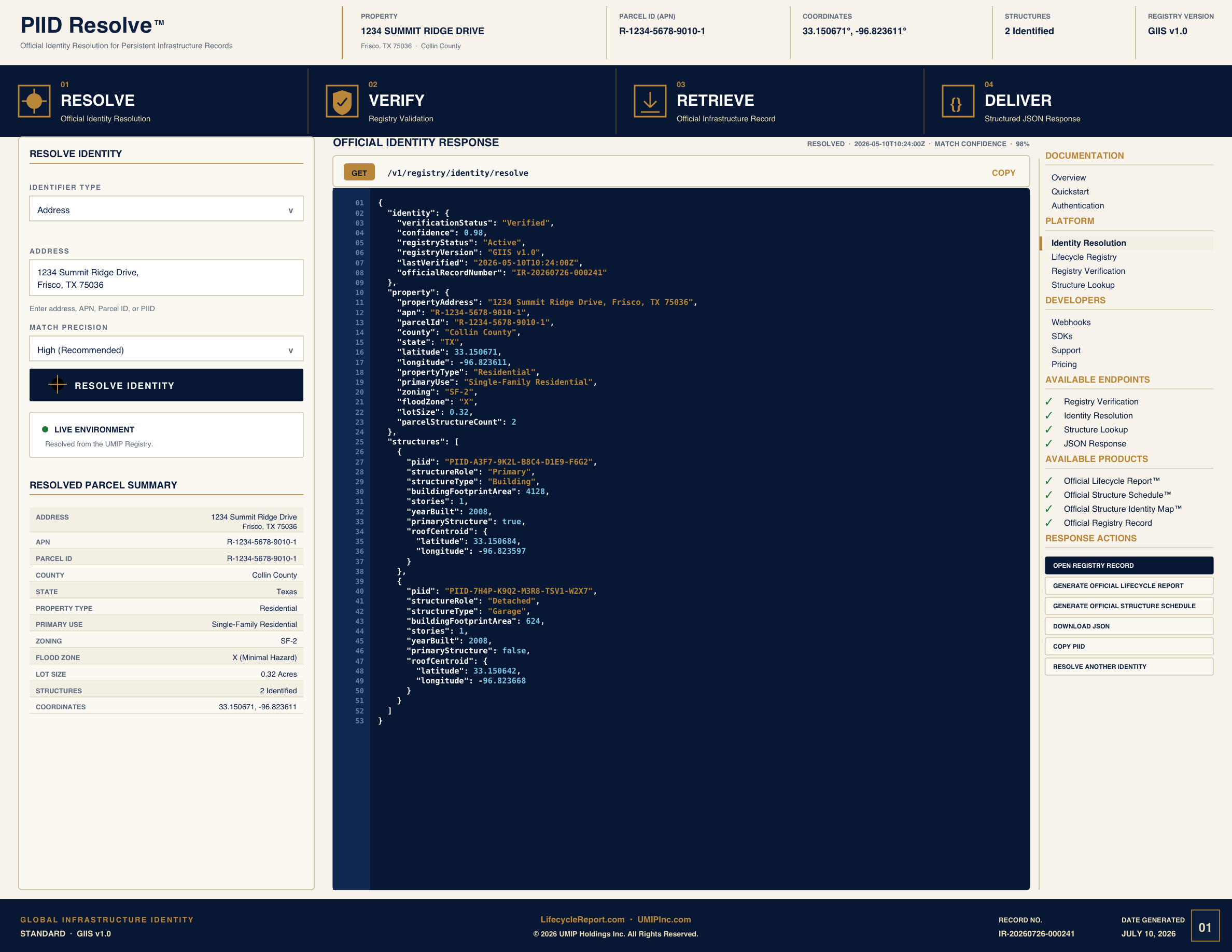
Identity Resolution API™

A real-world expression of the Infrastructure Identity Layer — resolving an identifier into an Official Infrastructure Identity Record.

PIID Resolve™ Structure Identity Resolution console resolving 1234 Summit Ridge Drive, Frisco, Texas, through four steps, Resolve, Verify, Retrieve, and Deliver, returning an Official Identity Response as structured JSON with verification status Verified and 98 percent match confidence.
Representative Identity Resolution API interface demonstrating registry-backed identity verification.

07 · GIIS™

Identity requires governance.

A permanent identifier is only as trustworthy as the standard that governs it. The Global Infrastructure Identity Standard (GIIS™) establishes the framework for persistent digital identity across infrastructure assets.

GIIS defines the Infrastructure Identity Layer, Persistent Infrastructure Identity, registry governance, interoperability, and pathways for adoption. It exists so identity can remain durable, neutral, and usable across industries and jurisdictions.

Standards are what make identifiers reliable. The systems that transformed vehicles, publishing, finance, and networks became foundational because they were governed as standards — not as products.

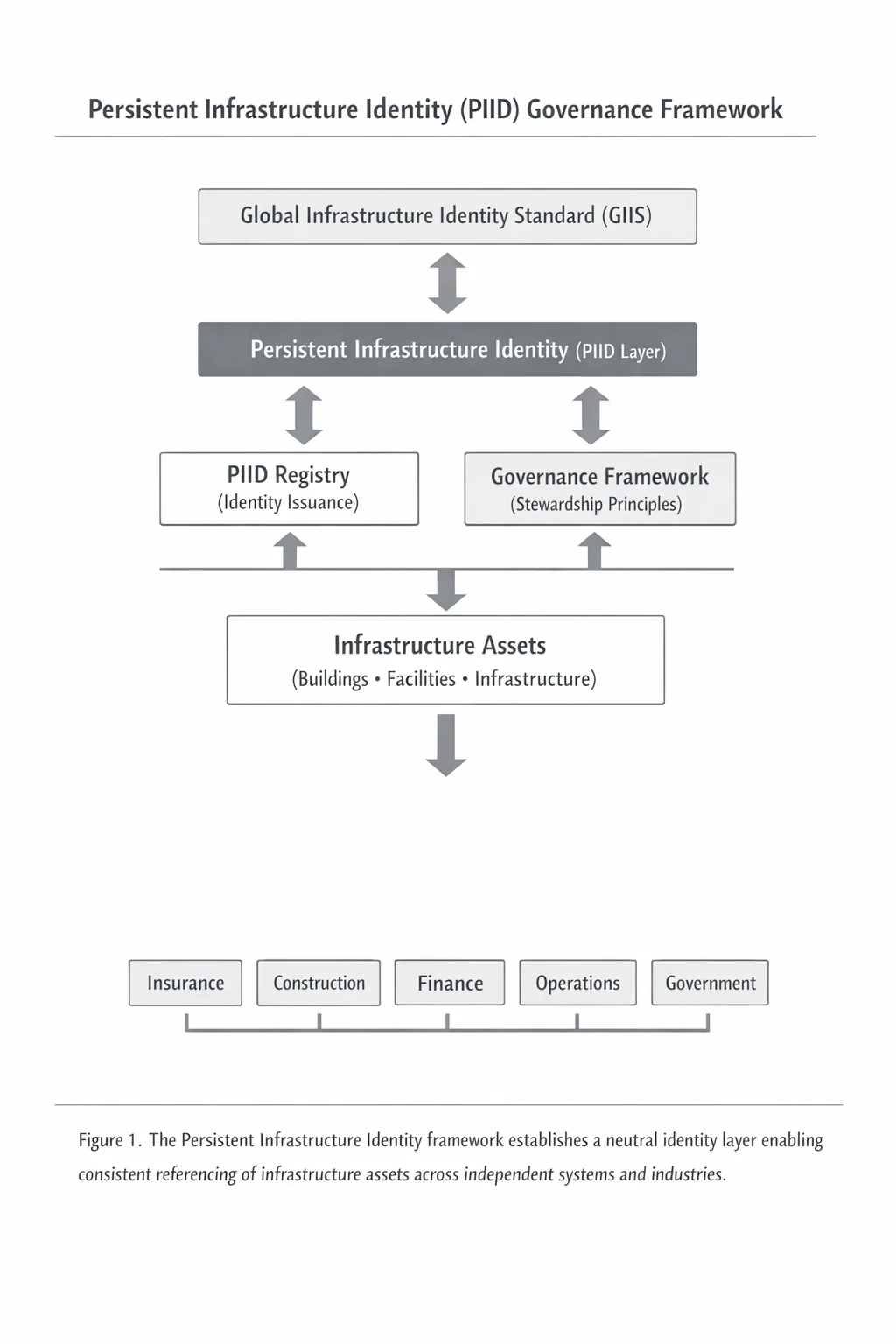
Approved figure

PIID Governance Framework

GIIS, the PIID layer, registry issuance, stewardship principles, infrastructure assets, and participating sectors.

PIID Governance Framework from the approved PIID Governance and Registry Framework

08 · Lifecycle

Events change. Identity remains.

Infrastructure moves through planning, construction, operations, renovation, insurance events, ownership transfer, inspection, disaster, demolition, and reconstruction. Each phase generates records. Each institution holds a fragment.

Without persistent identity, those fragments reset when systems change. With PIID, lifecycle history can reference the same structure across decades of institutional activity.

The identity remains constant. The record grows.

  • Construction
  • Ownership
  • Maintenance
  • Insurance
  • Renovation
  • Capital improvements
  • Inspection
  • Disaster
  • Demolition
  • Reconstruction

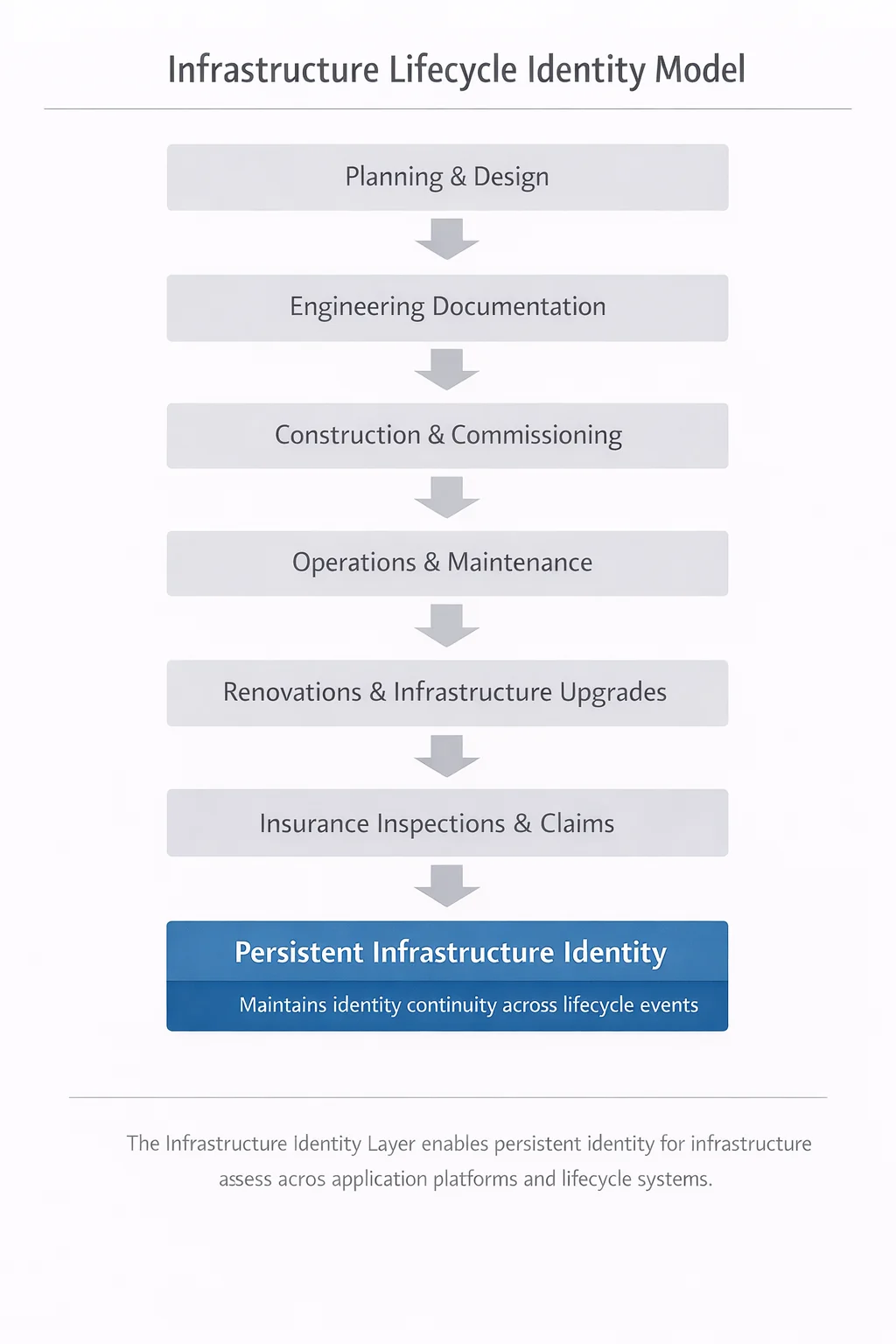
Approved figure

Infrastructure Lifecycle Identity Model

Persistent identity maintains continuity across planning, construction, operations, upgrades, inspections, claims, and ownership transitions.

Infrastructure Lifecycle Identity Model from the GIIS Foundational Standard

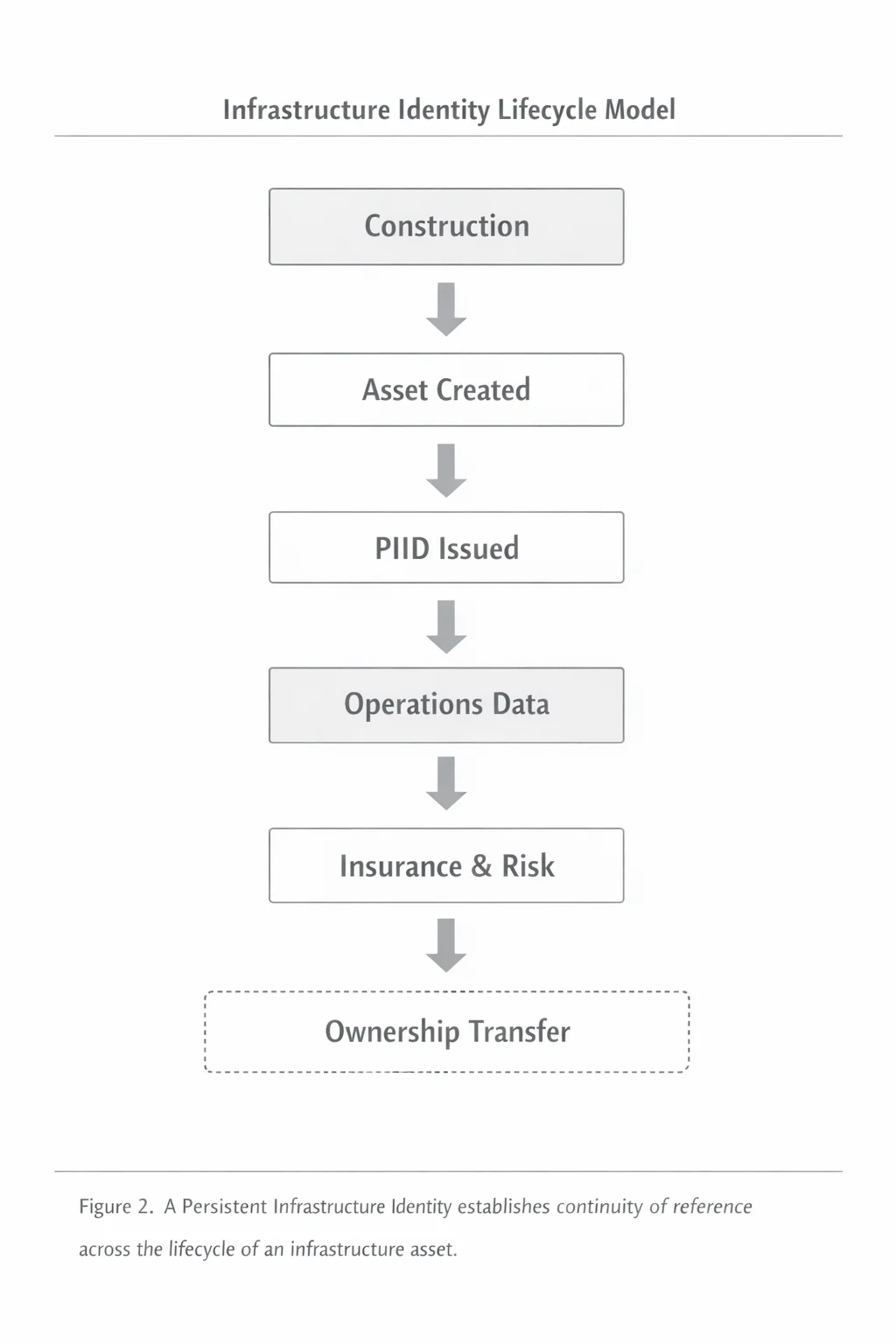
Approved figure

PIID Lifecycle Model

Continuity of reference from asset creation through operations, risk, and ownership transfer.

PIID Lifecycle Model from the approved PIID Governance and Registry Framework

09 · The future

Future systems inherit the identity layer they are given.

Digital twins, automation, infrastructure finance, insurance modernization, climate resilience, government systems, and smart-city programs all depend on the ability to refer to the same physical asset over time.

Artificial intelligence intensifies the requirement. Models can only join what identity makes joinable. Without a durable structure identity, advanced systems amplify fragmentation rather than resolve it.

The opportunity is not speculative. It is architectural. Institutions already operate the workflows. What they lack is the identity foundation those workflows assume.

  • Digital twins

    Models need a durable object identity to remain continuous.

  • Artificial intelligence

    PIID is the anchor that lets systems join fragmented signals into one structure.

  • Finance and insurance

    Underwriting, capital, and claims improve when history attaches to identity.

  • Resilience and government

    Disaster response and modernization require shared reference across agencies and records.

10 · The opportunity

The future of infrastructure requires a persistent digital identity.

The Infrastructure Identity Gap™ is no longer difficult to see. The built environment has outgrown proxy identifiers. The systems that depend on structures now require something structures themselves have never had: a permanent identity.

PIID™ and GIIS™ establish that foundation — a neutral identity layer, governed as a standard, preserved across the life of every structure.

Once infrastructure has an identity, everything downstream can finally reason about it.

UMIP

Roadmap

A mental model

From the problem to the applications that depend on identity.

  1. The Problem

  2. Infrastructure Identity Gap™

  3. PIID™

  4. GIIS™

  5. Identity Layer

  6. UMIP Registry™

  7. Applications

Continue exploring

UMIP Registry™

The system of record for durable structure records

Platform

PIID™ · Lifecycle™ · Registry™

Knowledge Center

Documentation, research, and the public record

Identity is the foundation everything else is built on.

Once infrastructure has an identity, everything downstream can finally reason about it.